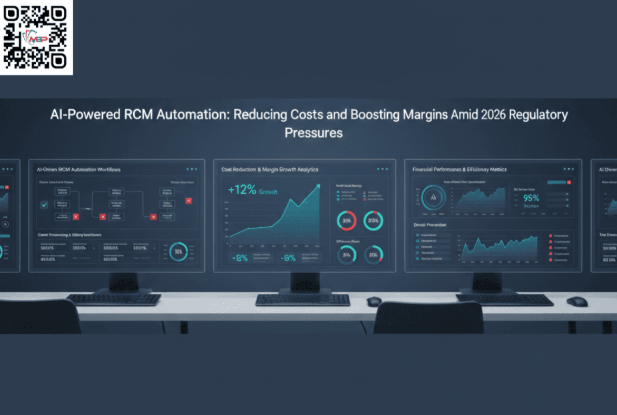

The healthcare industry has entered a “pivotal year of regulatory change and accelerated technology adoption,” according to recent 2026 industry outlooks. For many organizations, the traditional Revenue Cycle Management (RCM) model—historically a manual, back-office function—has become the primary driver of financial risk. In an era where 41% of providers report denial rates exceeding 10%, the move toward AI RCM Automation 2026 is no longer a luxury for the innovative few; it is a fundamental requirement for survival.
Rising labor costs, the complexity of new telehealth billing codes, and the pressure of the “One Big Beautiful Bill Act” (OBBBA) reforms have created a perfect storm. To weather it, healthcare leaders are turning to AI revenue cycle optimization to bridge the gap between shrinking margins and increasing operational demands.
The Economics of 2026: Why Manual RCM is Failing
As we navigate the first half of 2026, the data is clear: manual administrative transactions are costing the U.S. healthcare industry at least $20 billion annually. For the individual hospital or clinic, this translates to a “cost-to-collect” that has ballooned by over 15% in the last two years due to several factors:
- Clinical Labor Inflation: Administrative staff turnover remains at record highs, leading to constant retraining costs.
- Payer “Algorithmic Denial” Engines: Payers are now using sophisticated AI to audit claims in real-time, catching even minor documentation inconsistencies that previously went unnoticed.
- Regulatory Complexity: Federal requirements for Good Faith Estimates and faster prior authorization turnaround times (dropping from 14 days to just 7 days in 2026) have made manual tracking impossible.
3 Key Healthcare Revenue Cycle Trends 2026
To understand how to boost margins, we must look at the specific Healthcare Revenue Cycle Trends 2026 that are reshaping the industry.
- From RPA to “Agentic” AI
In previous years, providers used Robotic Process Automation (RPA) for simple, “if-this-then-that” tasks like eligibility checks. In 2026, we have transitioned to Agentic AI. These are autonomous agents that can “reason.” If an insurance verification fails, the AI doesn’t just stop; it identifies the error (e.g., a transposed digit in a member ID), cross-references the patient’s driver’s license scan, corrects the data, and re-verifies—all without human intervention.
- “Zero-Day” Denial Management
The 30-day denial cycle is officially dead. Leading organizations have implemented denial management automation that identifies a rejection within hours of submission. By correcting and resubmitting claims on the same business day, providers are seeing a dramatic reduction in “Days in A/R” and a significant boost in immediate cash flow.
- Unified Data and “Self-Healing” Workflows
System silos are the enemy of margin. In 2026, the trend is toward “self-healing” workflows where the billing system is natively integrated with the EHR and Health Information Management (HIM). When a physician updates a note, the AI automatically evaluates the new clinical data to determine if a different IPDRG code is required to ensure regulatory compliance billing.
Boosting Margins: The ROI of Automation
How much of a difference does automation actually make? Industry analyses suggest that broad AI adoption in healthcare could deliver up to $360 billion in annual savings nationwide. On a granular level, health systems implementing AI-based documentation review have reported reimbursement increases of approximately $13,000 per clinician.
| RCM Function | Manual Performance (Typical) | AI-Automated Performance (2026) |
| Claim Scrubbing | 85% Clean Claim Rate | 98% Clean Claim Rate |
| Eligibility Check | 5-10 minutes per patient | < 5 seconds (Real-time) |
| Denial Resolution | 14-21 Days | < 24 Hours |
| Documentation Review | 20-30 mins per record | < 2 mins with AI-Scribes |
Overcoming the Regulatory Hurdle with “My Billing Provider”
The intensified oversight from the OIG and CMS in 2026 means that “improper payments” are under a microscope. This is where My Billing Provider provides a strategic advantage. We understand that your practice doesn’t just need a software tool—it needs a compliance-first partner.
AI-Powered IPDRG Coding: Our Specialty
At My Billing Provider, we have perfected the art of autonomous coding. Our platform uses advanced algorithms to evaluate complex medical records and assign IPDRG codes with a level of precision that manual teams simply cannot match.
- Accuracy & Efficiency: We eliminate the “guesswork” and human fatigue that lead to downcoding and lost revenue.
- Customizable Solutions: Whether you are a rural clinic or a multi-state hospital network, our flexible platform is designed to handle your specific volume and complexity.
- Maximized Reimbursement: By ensuring every comorbid condition and complication is accurately captured, we help you realize the full value of the care provided.
Seamless Integration for 2026 Success
One of the biggest barriers to AI RCM Automation 2026 is the fear of system disruption. My Billing Provider solves this by fitting effortlessly into your existing procedures. We act as the “intelligence layer” on top of your current EHR, minimizing downtime while maximizing financial performance.
Conclusion: Reclaiming Your One Day a Week
Imagine if your billing staff could regain one full day per week by offloading routine tasks to intelligent agents. In 2026, that is the reality for providers who embrace AI revenue cycle optimization.
By automating the “drudge work,” you don’t just reduce costs; you empower your team to focus on high-value patient financial counseling and strategic growth. The regulatory pressures of 2026 are high, but the potential for margin expansion has never been greater for those with the right technology partner.
Is your revenue cycle ready for the scrutiny of 2026?
Contact My Billing Provider today to learn more about our AI-powered IPDRG coding and RCM solutions. Let our experts help you build a resilient, compliant, and highly profitable financial future.